Top Signs You Need Garage Door Service – Don’t Ignore These
The clearest signs you need garage door service are a door that moves slower than it used to, a sound that wasn’t there a month ago, or a door that won’t stay up when you lift it by hand. These aren’t “getting older” quirks. They’re mechanical warnings, and most of them show up weeks before something actually breaks. Here’s how to read them correctly.
If you’d rather not crawl around a door under tension, call (844) 443-4697. A quick diagnostic beats a snapped spring at 7 a.m.
Why Most Garage Door Failures Give You Weeks of Warning
Garage door hardware almost never fails without signaling first. Springs lose tension gradually. Bearings dry out. Cables fray one wire at a time. A track bends a fraction of an inch. Each of these changes produces a sound or a behavior change you can hear and feel long before the door stops working.
The problem is that homeowners read these signals as normal wear. A door that takes an extra two seconds to open isn’t “getting older” – it’s telling you the spring tension is dropping. On a standard torsion setup, that slow-down can mean you have roughly 200 cycles left before the spring lets go. At four open-and-close cycles a day, that’s about seven weeks. At eight cycles a day, it’s under a month.
We’re a garage door specialty company, so this is the work we do every day across Spring Hill. The pattern is consistent: the homeowners who call early pay for one repair. The ones who wait pay for a repair, a tow, and a day off work.
Below are the specific signals, what they mean mechanically, and how urgent each one really is.
What Are the Five Sounds That Mean You Need Garage Door Repair?
Sound is the most reliable diagnostic tool a garage door gives you. Each noise maps to a specific component. Our technicians have up to 8 years of experience reading these, and most of the time we can predict the failing part from the sound alone.
- Grinding: A worn drive gear in the opener or a dry trolley on the rail. If the grinding comes from overhead near the motor, it’s usually the gear. If it comes from mid-track, it’s the trolley. A dry trolley is a cheap fix. A stripped drive gear in a Genie or Chamberlain unit means the opener is close to done.
- Popping: A torsion spring coil binding on the shaft. This is the sound of a fatigued spring that’s about to fail. Popping means schedule spring service now, before the door drops.
- Scraping: A roller that’s jumped the track, or a bent track section rubbing the door edge. Inspect the track gap – it should stay consistent from top to bottom.
- Stuttering or jerking from the opener: Limit switch drift or a logic board fault. The opener thinks the door is somewhere it isn’t. This is common on older units and often misdiagnosed as a door problem.
- A heavy thud when the door closes: A broken or missing bottom bracket, or a door hitting a misadjusted travel limit. This one wears on the whole frame and should be fixed promptly.
One sound you should never treat as routine is a loud snap or a hard bang from the spring area. That’s a spring failure in progress. Stop using the door and call us for garage door repair.
The Balance Test: A Two-Minute Check You Can Do Yourself
The balance test is the single most useful thing a homeowner can do to catch spring problems early. It takes two minutes and requires no tools.
- Close the door and disconnect the opener using the release handle. That pulls the door off the motor.
- Lift the door by hand to about waist height.
- Let go.
A healthy door stays exactly where you left it. A door that drifts down on its own has weak springs. A door that rises on its own has springs that are set too tight. Neither is safe to leave alone, and both are early enough to fix before anything breaks.
One safety note: do the test by hand on the door panel, not on the springs, cables, or any hardware under tension. Never reach into the spring assembly or try to adjust it yourself. Torsion springs hold enormous stored energy, and a spring repair is the one garage door job that genuinely can injure you. That’s why we treat spring repair as front-line work, not an afterthought; our technicians carry the proper winding bars and know the safe procedure for each brand. If the door feels unusually heavy or the release cable won’t engage cleanly, skip the test and call us in Spring Hill.
Which Signs Mean Schedule Service, and Which Mean Stop Using the Door Today?
Not every warning is equally urgent. The difference between a 30-day repair and a “stop now” situation is whether the door still moves in a controlled way. Use this as a rough triage:
- Schedule within 30 days: A grinding sound that comes and goes. A door that closes unevenly but still closes. A slow opener. Popping from the spring only at the start of travel. A single roller that’s noisy. These are all early-stage problems with plenty of margin.
- Schedule this week: The balance test fails. The door reverses or stops partway. An opener that won’t respond to the remote or wall button. Any popping sound that appears at every cycle.
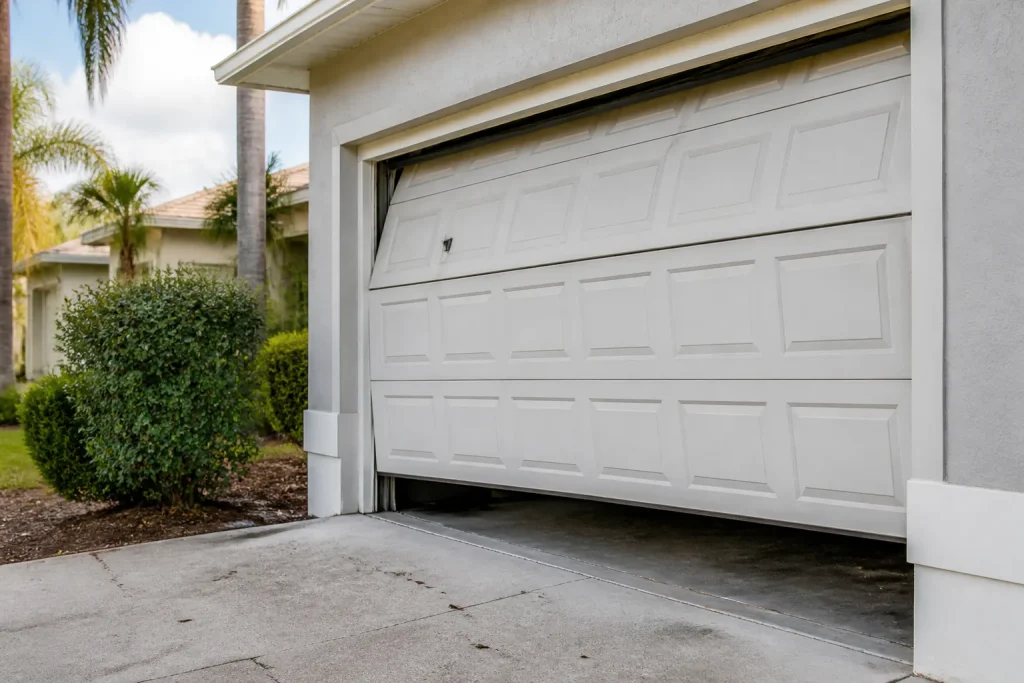
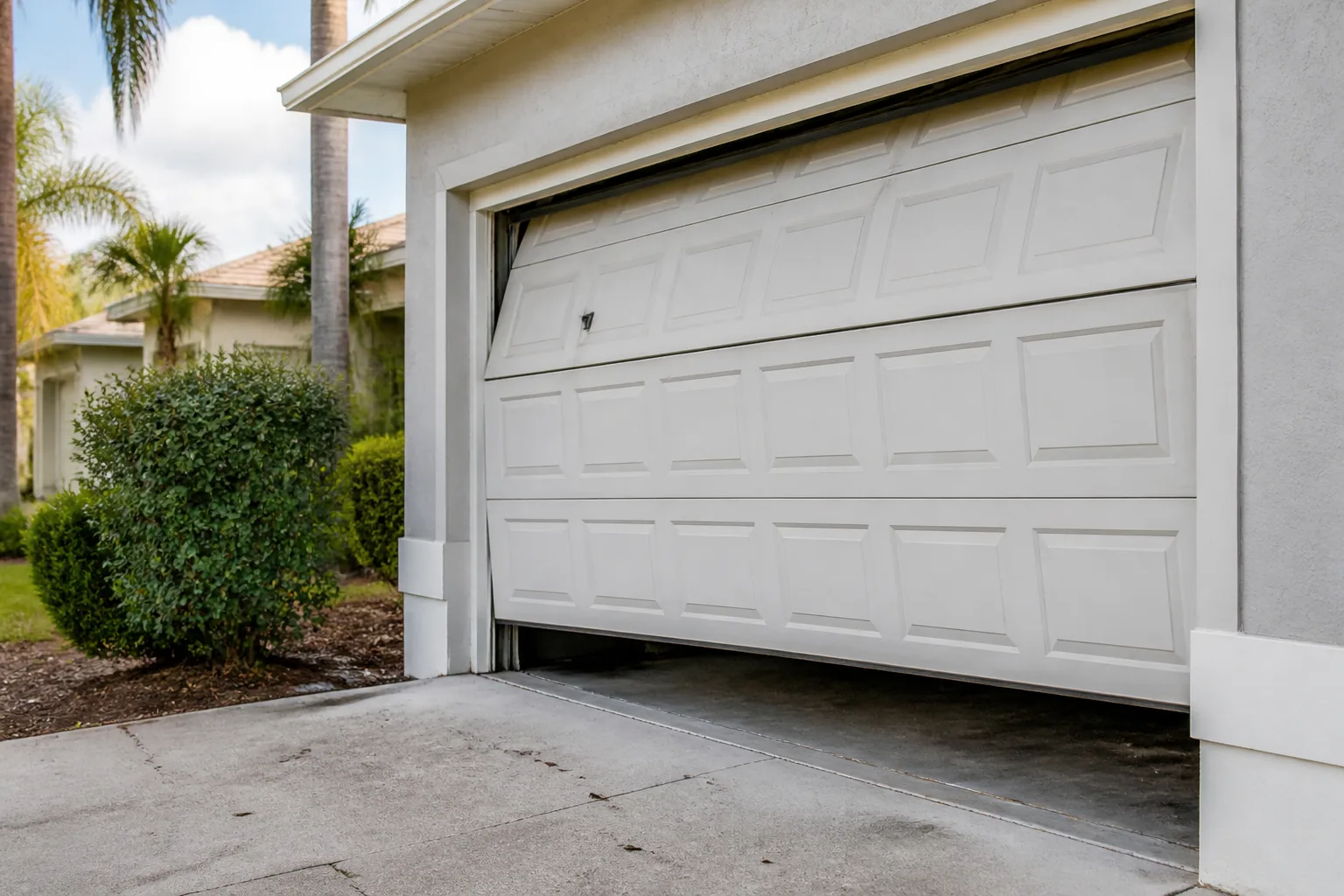
- Stop using the door today: A spring that has visibly snapped or separated. A cable that’s come off the drum. A door hanging off one track or visibly crooked. A door that won’t close and stays open. Any loud bang followed by a door that’s suddenly very heavy.
A door jammed open or a snapped spring leaves the house exposed and the car trapped. That’s why we treat emergency service as part of the core offering, not an add-on; broken springs, doors off-track, and dead openers in Spring Hill are exactly the calls we handle.
Related services in Spring Hill: if the door moves fine but the opener doesn’t, that’s an opener problem – see garage door opener repair. If the door itself is past repair or you’re choosing a new one, that’s garage door installation.
How Do Florida Conditions Speed Up Garage Door Failures in Spring Hill?
Garage doors in Spring Hill live in a tougher environment than the manufacturing specs assume. Three local factors push wear faster than a homeowner expects.
Humidity and cable wear. High humidity works on the steel strands inside cables. Cables don’t usually fail from load – they fail from the slow fraying that humidity accelerates. A cable that would last a decade in a dry climate can show broken strands in Spring Hill years sooner. Run your fingers lightly along a closed cable (with the door down, so it’s slack, never under tension) and look for a fuzzy, bristly feel. That’s fraying, and it means the cable should be replaced.
Heat expansion and track gaps. Warm days expand the metal in the track and the door panels. When the track gap shifts, rollers bind and the door scrapes. A track that was aligned in cool weather can develop a tight spot by afternoon. Look for the door edge rubbing the same spot every day.
Humidity-driven opener and bracket issues. The bottom bracket takes the full load of the door, and repeated moisture exposure loosens the fasteners over time. A thud on close is often a bottom bracket that’s worked loose.
Where you live in Spring Hill matters too. Homes closer to the coast see faster corrosion on hinges, brackets, and cables. Homes inland deal more with heat-expansion track movement. Either way, the schedule is shorter than the box tells you – which is why regular visual checks pay for themselves here.
Why “It Still Works” Is the Most Expensive Rationalization
Here’s the cost argument for acting early. When a torsion spring is fatigued but still intact, replacing it is a single, planned service call. When that same spring snaps, the failure usually takes the cable with it. The door drops. The opener may strip its gear trying to lift a door that won’t move. Now you’re looking at a spring, a cable, possibly an opener repair, and an emergency visit.
Replacing a spring on your schedule also lets you match parts correctly. Our technicians are factory-familiar with the hardware in LiftMaster, Chamberlain, Genie, Clopay, Amarr, Wayne Dalton, Craftsman, and Raynor systems – which means we know the exact spring and cable spec your door needs, not a generic substitute. A Clopay or Amarr door that fails mid-cycle at the wrong moment can leave you with the wrong part, a wait for the right one, and a car you can’t move.
We see it as preventive repair: a door with a fatigued spring isn’t a working door, it’s a door that happens to still open. The phone call after it snaps is always the more expensive one. In Spring Hill, if the opener still responds but the door sounds different, trust the sound and get it checked. Call us at (844) 443-4697 for a free estimate before a warning turns into an emergency.
The Bottom Line
Garage door hardware telegraphs its failures. Slower travel, new sounds, a door that won’t stay up, a thud on close – each of these is a specific component telling you it’s near the end of its service life. The five sounds (grinding, popping, scraping, stuttering, thudding) map to specific parts. The balance test takes two minutes and catches spring problems early. And in Spring Hill, humidity, heat expansion, and coastal corrosion all shorten the clock.
Key takeaways:
- Any popping sound from the spring area means schedule spring service now.
- A door that fails the balance test has weak springs – get it checked.
- A snapped spring, a hanging door, or a door stuck open is a stop-today situation.
- Frayed cables and loose bottom brackets are common in Spring Hill and cheap to fix early.
- Early repair is one visit. Emergency repair after a failure is usually several.
If you’re in Spring Hill and need help, Spring Hill Garage Door Repair Pros offers free estimates – call (844) 443-4697. We know your brand, we know the sound, and we’ll tell you honestly whether you’re looking at a 30-day fix or a call today.
Frequently Asked Questions
Repair is usually the right call when the door panels, tracks, and structure are sound and a specific component has failed – a spring, a cable, a roller, an opener. Replacement makes more sense when the panels are dented or rotted, the door is out of square, or repairs would cost close to a new door. A technician can tell you which side of that line you’re on during a free estimate in Spring Hill.
No. Torsion and extension springs hold stored energy that can cause serious injury, and the proper winding tools and procedure vary by door and brand. Spring repair is the highest-risk job in garage door work. Have a trained technician handle it.
Popping usually means a coil on the torsion spring is binding against the shaft as the door moves. That spring is fatigued and near failure. Stop cycling the door and schedule spring service right away.
Cost depends on the specific failure – a roller replacement is minor, while a spring or opener replacement is a larger job. Call (844) 443-4697 for a free estimate; we’ll give you a written price before any work starts, so you know what you’re paying for.
Written by the team at Spring Hill Garage Door Repair Pros.
Need Garage Door Help?
Call Spring Hill Garage Door Repair Pros - the local pro we connect you with is licensed and insured, here with fast after-hours help in Spring Hill.
(844) 443-4697